


Your shopping cart is empty!
Carrot "Nantes 2" (50,0 g)
Prof Pack

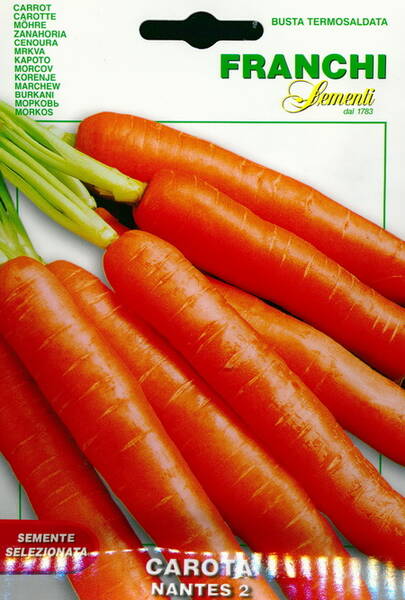
Carrot "Nantes 2".
A mid-season, high-yielding variety (the period from germination to technical ripeness is 80-100 days).
The root crops are of excellent quality, cylindrical, 12-16 cm long, weighing up to 100 g, with a blunt tip.
The flesh is bright orange, juicy, tender, with excellent taste qualities. Contains up to 19.4% carotene.
The variety is intended for fresh consumption and processing.
The high carotene content in the root crops makes them indispensable for preparing baby and diet food.
The root crops store perfectly, which extends the period of carrot consumption until the new harvest.
Agrotechnics.
Carrots grow best on light loamy and sandy loam soils. The best predecessors are considered to be: potatoes, onions, tomatoes, cucumbers, legumes.
In the spring, before sowing, a complex mineral fertilizer is applied to the soil. Sowing in late April in furrows to a depth of 3-4 cm. The distance between rows is 18-25 cm.
2 weeks after germination, the carrots are thinned out. The second thinning is carried out when the root crops reach 1 cm in diameter, leaving 5-6 cm between the plants.
Further care consists of weeding, loosening, and watering. Winter sowings are carried out when the temperature drops to +5 °C (the second half of October - early November).
The seeds are planted to a depth of 1-2 cm, the surface of the site is mulched with peat.
A mid-season, high-yielding variety (the period from germination to technical ripeness is 80-100 days).
The root crops are of excellent quality, cylindrical, 12-16 cm long, weighing up to 100 g, with a blunt tip.
The flesh is bright orange, juicy, tender, with excellent taste qualities. Contains up to 19.4% carotene.
The variety is intended for fresh consumption and processing.
The high carotene content in the root crops makes them indispensable for preparing baby and diet food.
The root crops store perfectly, which extends the period of carrot consumption until the new harvest.
Agrotechnics.
Carrots grow best on light loamy and sandy loam soils. The best predecessors are considered to be: potatoes, onions, tomatoes, cucumbers, legumes.
In the spring, before sowing, a complex mineral fertilizer is applied to the soil. Sowing in late April in furrows to a depth of 3-4 cm. The distance between rows is 18-25 cm.
2 weeks after germination, the carrots are thinned out. The second thinning is carried out when the root crops reach 1 cm in diameter, leaving 5-6 cm between the plants.
Further care consists of weeding, loosening, and watering. Winter sowings are carried out when the temperature drops to +5 °C (the second half of October - early November).
The seeds are planted to a depth of 1-2 cm, the surface of the site is mulched with peat.
* The seeds of this crop germinate slowly and unevenly. With standard sowing, the seedlings are often sparse and uneven.
Another matter is fluid drilling (liquid sowing). It allows you to get early and uniform seedlings.
This method of sowing was developed in England and has been confirmed in practice. What is its essence?
Pre-sprouted seeds are sown in a liquid gel-like carrier, which protects them from damage. At the same time, seedlings appear 5-7 days earlier, plants develop faster than with standard sowing of dry seeds, and the yield increases. The greatest effect of sowing sprouted seeds can be obtained when growing carrots for early production with film cover, which will accelerate the harvest by 2-3 weeks.
Sowing of carrots is carried out early in the spring, as soon as the soil is ready, but in such a way as to prevent the freezing of sprouted seeds in the ground. In the conditions of the middle zone, sowing is usually carried out in the second half of April - early May, depending on the weather. It is better to carry out the main tillage of the soil on the site in the autumn so as not to delay sowing in the spring.
Seed preparation begins 2-4 days before sowing. For swelling, the seeds are soaked in warm water for 10-12 hours; the water is changed several times, removing the lightweight floating seeds.
Then the water is drained, the swollen seeds are scattered in a thin layer on a plate covered with a cloth or filter paper. On top, the seeds are covered with a clean, damp, loose cloth.
Seed germination is carried out in a warm place at a temperature of +20...+25 °C. To do this, the seeds must be moist; care is taken to ensure they do not dry out. However, an excess of water is undesirable, as it makes it difficult for oxygen, which is necessary for germination, to enter.
After the appearance of the first roots, mixing of the seed layer is not carried out, or it is done very carefully without damaging the sprouts. During this period, the moisture content of the seeds is monitored especially carefully, and water is added if necessary, since the need for moisture increases as the roots grow.
The duration of seed germination also depends on the ambient temperature. But still, the average duration of germination is 2-4 days.
Germination is carried out until roots appear in the bulk of the sprouted seeds with a length of no more than 0.5 cm. Single seeds may have roots up to 1.5 cm long. The amount of sprouted material in the batch by this time is usually from 20 to 40%.
To get a more uniform seed material, you can daily select sprouted seeds with roots from 2 to 5 mm and store them in the refrigerator at a temperature of +1...+4 °C in a damp cloth in a plastic bag.
When sowing selected sprouted seeds, the germination rate and the uniformity of seedling emergence significantly increase. However, the selection is very laborious and requires great care and attention so as not to damage the roots and prevent them from drying out. It can be carried out only when sowing on a small area.
There is another way to germinate seeds - in aerated water. It is simple and convenient. The seeds are placed in water, through which air is passed using an aquarium microcompressor during the entire germination time. The seeds should be well mixed by the air flow. Pre-soaking of seeds may not be carried out, but 10-12 hours after the start of aeration, the water is replaced. In aerated water, seed germination proceeds more uniformly.
If the seeds are prepared for sowing, but the latter is delayed for any reason, then the sprouted seeds are kept in the refrigerator in a moist state in a plastic bag at a temperature of +1...+4 °C, preventing them from freezing and drying out.
According to foreign scientists, such hardening of sprouted seeds not only does not deteriorate their quality, but also contributes to an increase in field germination. Sprouted seeds are sown in a liquid gel-like carrier. Abroad, a number of specially obtained preparations are used for this purpose. In a personal plot, you can successfully use a paste made from potato starch, which is affordable and completely harmless. The paste is prepared in advance so that it has time to cool, but not earlier than a day before.
The main requirement for starch paste is that it must be homogeneous, without lumps, and viscous enough to keep the sprouted seeds in suspension.
Such a paste is obtained as follows. To prepare 1 liter of paste, 30 g of potato starch must be stirred in 100 ml of cold water.
900 ml of boiling water is poured into a liter jar, and the diluted starch is added to it in a thin stream with constant stirring. Then the liter jar is placed in a pan with boiling water and, while stirring, the resulting starch paste is heated to a temperature of +92 °C.
After that, it is cooled, stirring occasionally to prevent the formation of a film on the surface. If it still forms, after cooling the preparation to room temperature, it is removed. The liquid gel carrier for sowing sprouted seeds is ready.
It is very important to calculate the required amount of seeds and starch paste in advance to obtain the optimal plant density and avoid sparse or thickened seedlings.
To do this, you need to know the germination of the seeds. It is determined approximately at home by germinating 100 seeds at a temperature of +20...+25 °C for 10-15 days and counting the number of sprouted ones. The optimal number of seedlings per 1 m of a row with a row spacing of 25 cm is 50-60 pcs.
To get a normal stand of plants for every 10 m of row length, 2 g (with a germination rate of 70% and higher) to 3 g (with a germination rate of 50%) of dry seeds are placed for germination and 200 ml of starch paste is prepared.
Sprouted seeds are mixed with paste cooled to room temperature immediately before sowing. The mixture is prepared at once for the entire sown area.
The seeds are mixed with the paste very carefully, without damaging the roots, until the seeds are evenly distributed in the liquid. Sprouted seeds can remain in starch for no more than 6 hours, otherwise their germination will decrease.
Sowing is carried out in pre-watered furrows. The mixture of seeds with paste is poured in a thin stream of 20 ml per 1 m of the row. It is convenient to do this using a glass cup with a "spout" of 100 ml or a specially made syringe. With a little skill, it is easy to achieve a uniform distribution of the liquid with seeds in the row.
Immediately after sowing, the furrows are covered with loose soil. The seeding depth is 1.5-2 cm. Until emergence, the soil is kept moist; watering is carried out if necessary. Fluid drilling with sprouted seeds can also be used for other small-seeded vegetable crops, such as dill, parsley, onions.